
Đáp án đề thi môn Tiếng Anh tốt nghiệp THPT 2025 (đề chính thức) được cập nhật nhanh và chính xác nhất tại Tailieuonthi.org.
Tham khảo: Đáp án đề thi môn Toán tốt nghiệp THPT 2025 (đề chính thức)
Đề thi môn Tiếng Anh tốt nghiệp THPT 2025
Hình ảnh đề thi mã 1105
Hình ảnh đề thi mã 1106
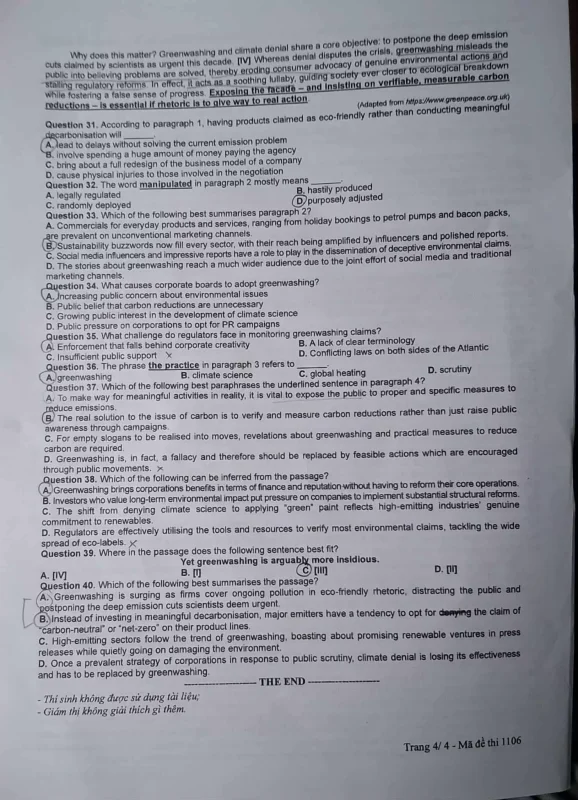
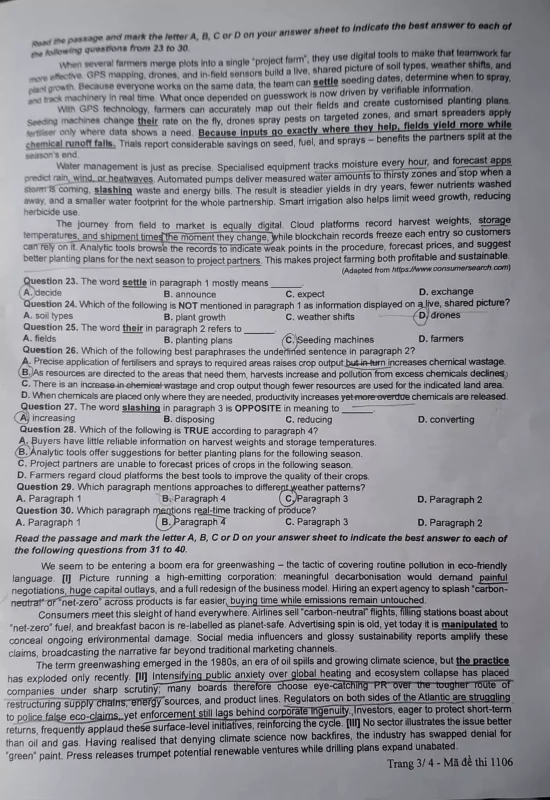
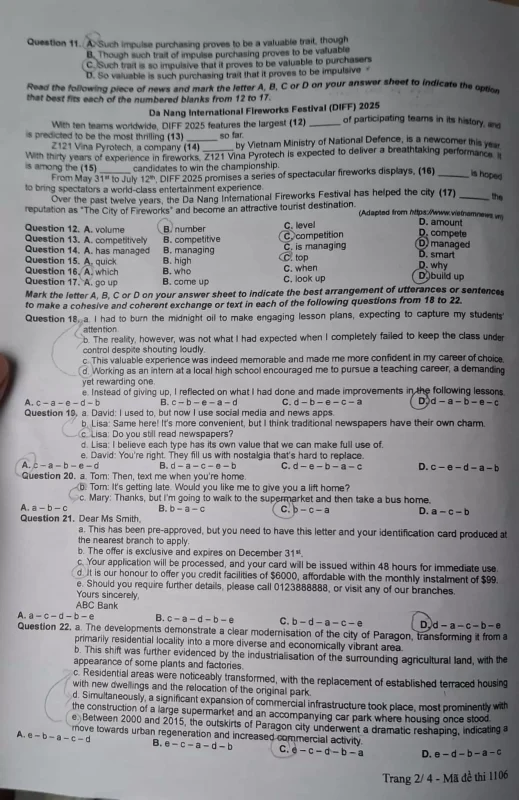
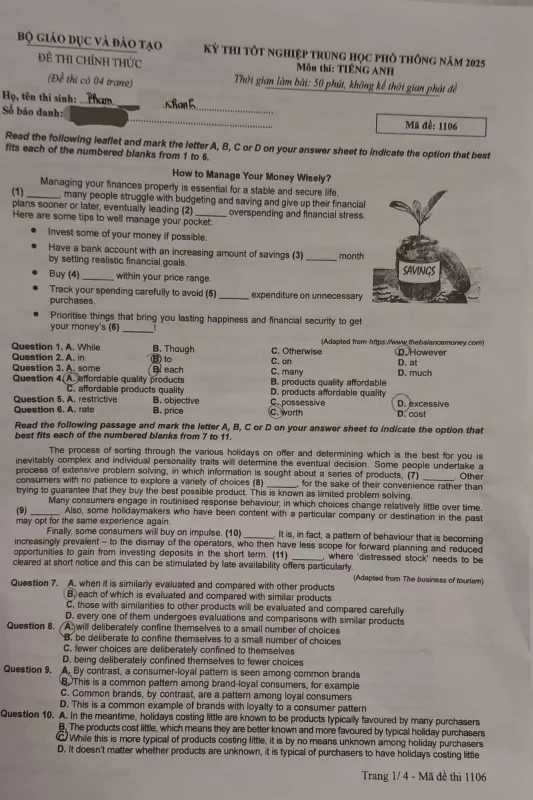
Nội dung đề thi – Mã đề: 1105
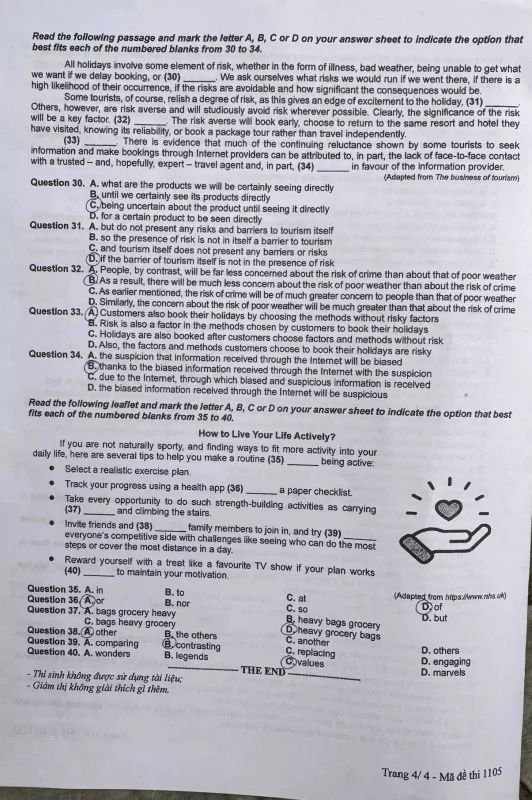
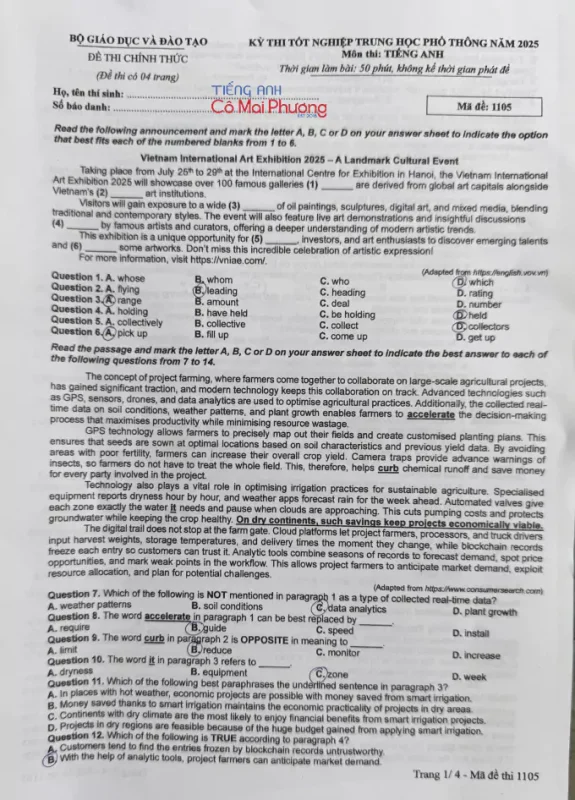
Read the following announcement and mark the letter A, B, C or D on your answer sheet to indicate the option that best fits each of the numbered blanks from 1 to 6.
Vietnam International Art Exhibition 2025 – A Landmark Cultural Event
Taking place from July 25th to 29th at the International Centre for Exhibition in Hanoi, the Vietnam International Art Exhibition 2025 will showcase over 100 famous galleries (1) __________ are derived from global art capitals alongside Vietnam’s (2) __________ art institutions.
Visitors will gain exposure to a wide (3) __________ of oil paintings, sculptures, digital art, and mixed media, blending traditional and contemporary styles. The event will also feature live art demonstrations and insightful discussions (4) __________ by famous artists and curators, offering a deeper understanding of modern artistic trends.
This exhibition is a unique opportunity for (5) __________ investors, and art enthusiasts to discover emerging talents and (6) __________ some artworks. Don’t miss this incredible celebration of artistic expression! For more information, visit https://viniae.com/.
(Adapted from https://english.vnw.vn)
Question 1. A. whom B. whom C. who D. what
Question 2. A. flying B. leading C. heading D. rating
Question 3. A. range B. amount C. deal D. number
Question 4. A. holding B. being held C. be holding D. held
Question 5. A. collectively B. collective C. collect D. collectors
Question 6. A. pick up B. fill up C. come up D. get up
Read the passage and mark the letter A, B, C or D on your answer sheet to indicate the best answer to each of the following questions from 7 to 14.
The concept of project farming, where farmers come together to collaborate on large-scale agricultural projects, has gained significant traction, and modern technology keeps this collaboration on track. Advanced technologies such as GPS sensors, drones, and data analytics are used to optimise agricultural practices. Additionally, the collected real-time data on soil conditions, weather patterns, and plant growth enables farmers to make data-driven decision-making process that maximises productivity while minimisng resource wastage.
GPS technology allows farmers to precisely map out their fields and create customised planting plans. This ensures that seeds are sown at optimal locations, based on soil characteristics and previous yield data. By avoiding areas with poor fertility, farmers can increase their overall crop yield. Camera traps provide advance warnings of insects, so farmers do not have to treat the whole field. This, therefore, helps curb chemical runoff and save money for every party involved in the field.
Technology also plays a vital role in optimising irrigation practices for sustainable agriculture. Specialised equipment reports dryness hour by hour, and weather data forecast the next week’s need. Automated valves give each zone exactly the water it needs and pause when clouds are approaching. This cuts pumping costs and protects groundwater while keeping the crop healthy. On dry continents, such savings keep projects economically viable.
The digital trail does not stop at the farm level. Cloud platforms let project leaders, processors, and truck drivers input harvest weights, storage temperatures, and delivery times the moment they change. While blockchain records freeze data entry so customers can trust it. Analytic tools combine seasons of records to forecast demand, spot price opportunities, and help drive profits in the market. This allows project farmers to anticipate market demand, exploit resource allocation, and plan for potential challenges.
(Adapted from https://www.consumersearch.com)
Question 7. Which of the following is NOT mentioned in paragraph 1 as a type of connected real-time data? A. weather patterns B. soil conditions C. data analytics D. plant growth
Question 8. The word accelerate in paragraph 1 can be best replaced by A. require B. slide C. speed D. install
Question 9. The word curb in paragraph 2 is OPPOSITE in meaning to A. limit B. hinder C. monitor D. increase
Question 10. The word it in paragraph 3 refers to A. dryness B. equipment C. zone D. week
Question 11. Which of the following is NOT paraphrases the underlined sentence in paragraph 3? A. In places with hot weather, economic projects are possible with money saved from smart irrigation. B. Money saved due to smart irrigation maintains the economic practicality of projects in dry areas. C. Countries with dry seasons are the most likely to enjoy financial benefits from smart irrigation projects. D. Projects in dry regions are feasible because of the huge budget gained from applying smart irrigation.
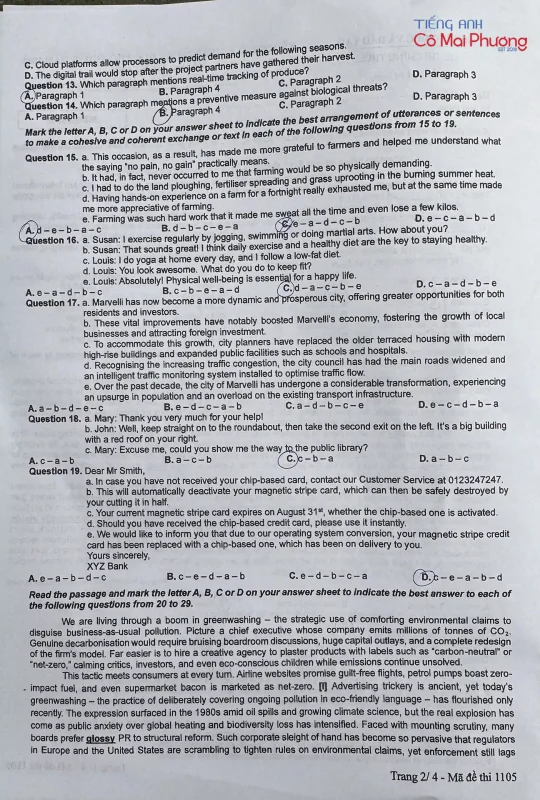
Question 12. Which of the following TRUE according to paragraph 4? A. Customers tend to trust the figures from blockchain records unswervingly. B. With the help of analytic tools, project farmers can anticipate market demand.
Question 13. Cloud platforms allow processors to predict demand for the following seasons. D. Paragraph 3 Question 14. Which paragraph mentions a negative measure against biological threats? D. Paragraph 3 A. Paragraph 2 B. Paragraph 4 C. Paragraph 2 D. Paragraph 4
Read the letter A, B, C or D on your answer sheet to indicate the best arrangement of utterances or sentences to make a cohesive and coherent exchange or text in each of the following questions from 15 to 19.
Question 15. a. This occasion, as a result, has made me more grateful to farmers and helped me understand what the saying ‘no pain, no gain’ practically means. b. In fact, it never occurred to me that farming would be so physically demanding. c. It had to be the land ploughing, fertiliser spreading, and grass uprooting in the burning summer heat. d. Having hands-on experience on a farm for a fortnight really exhausted me, but at the same time made me more appreciative of farming. e. Farming was such hard work that it made me sweat all the time and even lose a few kilos. A. d-e-b-c-a B. a-d-c-e-a C. a-d-b-c-e D. c-e-a-b-d
Question 16. a. Susan: I exercise regularly by jogging, swimming or doing martial arts. How about you? b. Susan: That sounds great. I think daily exercise and a healthy diet are the key to staying healthy. c. Louis: I do yoga at home every day, and I follow a low-fat diet. d. Louis: You look awesome. What do you do to keep fit? e. Louis: Absolutely! Physical well-being is essential for a happy life. A. e-a-d-b-c B. b-c-e-a-d C. d-a-c-b-e D. c-a-d-b-e
Question 17. a. MarvelI now has become a more dynamic and prosperous city, offering greater opportunities for both residents and investors. b. These vital improvements now nobody boosted MarvelI’s economy, fostering the growth of local businesses and attracting foreign investment. c. To accommodate the growth, city planners have replaced the older terraced housing with modern high-rise buildings and expanded public facilities such as schools and hospitals. d. Recognizing the increasing traffic congestion, the city council now has the main roads widened and an intelligent traffic monitoring system installed to optimise traffic flow. e. Over the past decade, the city of MarvelI has undergone a considerable transformation, experiencing its post-war in population and an overhaul in the existing transport infrastructure. A. a-b-d-e-c B. e-d-c-a-b C. a-d-b-c-e D. e-c-d-b-a
Question 18. a. Mark: Thank you very much for your help! b. John: Well, keep straight on to the roundabout, then take the second exit on the left. It’s a big building with a red roof on your right. c. Mary: Excuse me, could you show me the way to the public library? A. c-a-b B. a-b-c C. c-b-a D. a-b-c
Question 19. Dear Mr. Smith, a. In case you have not received your chip-based card, contact our Customer Service at 0123247247. b. This will automatically deactivate your magnetic stripe card, which can then be safely destroyed by your cutting it in half. c. Your current magnetic stripe card expires on August 31st, whether the chip-based one is activated. d. You should have received the chip-based credit card, please use it instantly. e. We would like to inform you that due to our operating system conversion, your magnetic stripe credit card has been replaced with a chip-based one, which has been on delivery to you. Yours sincerely, XYZ Bank A. e-a-b-c-d B. c-e-d-b-a C. e-d-b-c-a D. c-e-a-b-d
Read the passage and mark the letter A, B, C or D on your answer sheet to indicate the best answer to each of the following questions from 20 to 29.
We are living through a boom in greenwashing – the strategic use of comforting environmental claims to disguise business-as-usual pollution. Picture a chief executive whose company emits millions of tonnes of CO2. Genuine decarbonisation would require bruising boardroom discussions, huge capital outlays, and a complete redesign of the firm’s model. For easier is to hire a creative agency to pepper products with labels such as “carbon-neutral” or “net-zero,” “climate-crisis,” “investor,” and even eco-conscious children with whimsical corporate mascots.
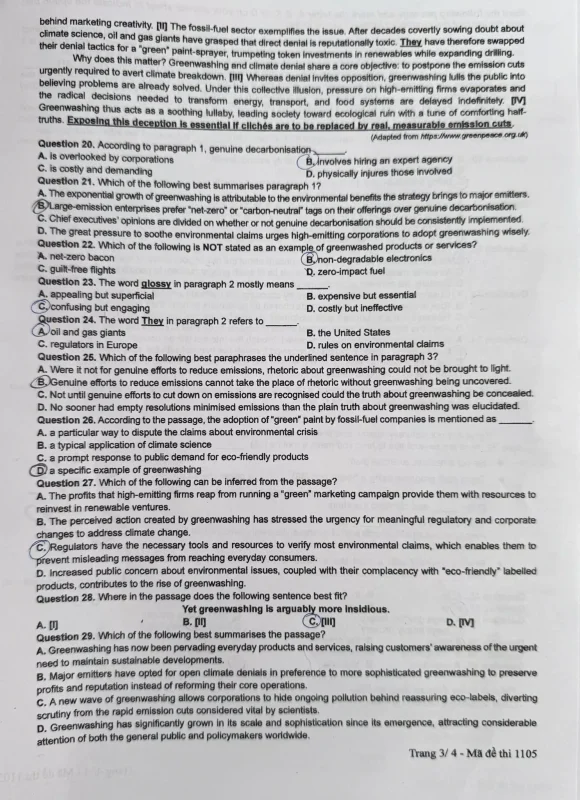
This tactic meets consumers at every turn. Airline websites promise guilt-free flights, petrol pumps boast zero-impact fuel, and even supermarket bacon is marketed as net-zero. If advertising trickery is ancient, yet today’s greenwashing – the practice of deliberately covering ongoing pollution in eco-friendly language – has flourished only recently. The expression surfaced in the 1980s amid oil spills and growing climate science, but the real explosion has come as public anxiety over global heating and biodiversity loss has intensified. Faced with mounting scrutiny, many boards prefer glossy, PR to structural reform. Such corporate sleight of hand has become so pervasive that regulators in Europe and the United States are scrambling to tighten rules on environmental claims, yet enforcement still lags. behind marketing creativity. [I] The fossil-fuel sector exemplifies the issue. After decades covertly sowing doubt about climate science, oil and gas giants have grasped that direct denial is reputationally toxic. They have therefore swapped their denial tactics for a ‘green’ paint-brush, trumpeting token investments in renewables while expanding drilling.
Why does this matter? Greenwashing has immediate denial sharp’s core objective: to undermine the emission cuts urgently required to avert climate breakdown. [II] When influential bodies espouse, greenwashing lulls the public into believing problems are already solved. Under this collective illusion, pressure on high-emitting firms evaporates and the radical decisions needed to transform energy, transport, and food systems are delayed indefinitely. [III] Greenwashing thus acts as a soothing lullaby, leading society toward ecological ruin with a tune of comforting half-truths. Exposing this deception is essential if clichés are to be replaced by real, measurable emission cuts. (Adapted from https://www.greenpeace.org)
Question 20. According to paragraph 1, genuine decarbonisation A. is overlooked by corporations B. involves hiring an expert agency C. is costly and demanding D. physically injures those involved
Question 21. Which of the following best summarises paragraph 1? A. The exponential rise of greenwashing is attributable to the environmental benefits the strategy brings to major emitters. B. Large-emission enterprises prefer “net-zero” or “carbon-neutral” tags on their offerings over genuine decarbonisation. C. Chief executives’ opinions are divided on whether or not genuine decarbonisation should be consistently implemented. D. The great pressure to soothe environmental claims urges high-emitting corporations to adopt greenwashing wisely.
Question 22. Which of the following is NOT stated as an example of greenwashed products or services? A. net-zero bacon B. non-degradable electronics C. guilt-free flights D. zero-impact fuel
Question 23. The word glossy in paragraph 2 mostly means A. appealing but superficial B. expensive but essential C. confusing but engaging D. costly but ineffective
Question 24. The word They in paragraph 2 refers to A. oil and gas giants B. the United States C. regulators in Europe D. rules on environmental claims
Question 25. Which of the following best paraphrases the underlined sentence in paragraph 3? A. Here is not genuine efforts to reduce emissions, rhetoric about greenwashing could not be brought to light. B. Genuine efforts to reduce emissions cannot get lost in the noise of a greenwashing campaign, it must be uncovered. C. Not until genuine efforts to cut down on emissions are recognised could the truth about greenwashing be concealed. D. No sooner had empty resolutions minimised emissions than the plain truth about greenwashing was elucidated.
Question 26. According to the passage, the adoption of “green” paint by fossil-fuel companies is mentioned as A. a particular key to global climate claims about environmental crisis B. a typical application of climate science C. a prompt response to public demand for eco-friendly products D. a specific example of greenwashing
Question 27. Which of the following can be inferred from the passage? A. The profits that high-emitting firms reap from running a “green” marketing campaign provide them with resources to reinvest in renewable ventures. B. The perceived action created by greenwashing has stressed the urgency for meaningful regulatory and corporate changes to address climate change. C. Corporations have the necessary tools and resources to verify most environmental claims, which enables them to prevent misleading messages from reaching everyday consumers. D. Increased public concern about environmental issues, coupled with their complacency with “eco-friendly” labelled products, contributes to the rise of greenwashing.
Question 28. Where in the passage does the following sentence best fit? Yet greenwashing is arguably more insidious. A. [I] B. [II] C. [III] D. [IV]
Question 29. Which of the following best summarises the passage? A. Greenwashing has now been pervading everyday products and services, raising customers’ awareness of the urgent need to maintain sustainable developments. B. Major emitters have opted for open climate denials in preference to more sophisticated greenwashing to preserve profits and reputation instead of reforming their core operations. C. A new wave of greenwashing allows corporations to hide ongoing pollution behind reassuring eco-labels, diverting scrutiny from the rapid emission cuts considered vital by scientists. D. Greenwashing has significantly grown in its scale and sophistication since its emergence, attracting considerable attention of both the general public and policymakers worldwide.
Read the following passage and mark the letter A, B, C or D on your answer sheet to indicate the option that best fits each of the numbered blanks from 20 to 34.
All holidays involve some element of risk, whether in the form of illness, bad weather, being unable to get what we want if we delay booking, or (30) __________. We ask ourselves what risks we would run if we went there, if there is a high likelihood of their occurrence, if the risks are avoidable and how significant the consequences would be. Some tourists, of course, return a progress, so that this gives an edge of excitement to the holiday, (31) Others, however, are risk averse and will studiously avoid risk wherever possible. Clearly, the significance of the risk will be a key factor, (32) __________. The risk averse will book early, choose to return to the same resort and hotel they have visited, showing its reliability, or book a package tour rather than travel independently. (33) __________ There is evidence that much of the continuing reluctance shown by some tourists to seek information and make bookings through Internet providers can be attributed to, in part, the lack of face-to-face contact with a trusted – and, hopefully, expert – travel agent and, in part, (34) __________ in favour of the information provider. (Adapted from The business of tourism)
Question 30. A. what are the products will be certainly seeing directly B. until we certainly see its products directly C. being uncertain about the product until seeing it directly D. or a certain product to be seen directly Question 31. A. but do not present of risks and dangers to tourism itself B. so the presence of risk is not in itself a barrier to tourism C. yet, tourism itself does not present any barriers or risks D. if the barrier of tourism itself is not in the presence of risk Question 32. A. People, by contrast, will be far less concerned about the risk of crime than than about of poor weather B. as a result, there will be much less concerned about the risk of poor weather than about the risk of crime C. As earlier mentioned, the risk of crime will be of much greater concern to people than that of poor weather D. Similarly, the concern about the risk of poor weather will be much greater than that about the risk of crime Question 33. A. Customers also book their holidays by knowing the methods without risky factors B. Risk is also a factor in the methods chosen by customers to book their holiday C. Holidays are also booked after customers choose factors and methods without risk D. Also, the factors and methods customers choose to book their holidays are risky Question 34. A. the suspicion that information received through the Internet will be biased B. thanks to the biased information received through the Internet with the suspicion C. due to the Internet, through which biased and suspicious information is received D. the biased information received through the Internet will be suspicious
Read the following leaflet and mark the letter A, B, C or D on your answer sheet to indicate the option that best fits each of the numbered blanks from 35 to 40.
How to Live Your Life Actively! If you are not naturally sporty, and finding ways to fit more activity into your daily life, here are several tips to help you make a routine (35) __________ being active:
- Select a realistic exercise plan.
- Track your progress using a health app (36) __________ a paper checklist.
- Take every opportunity to use strength-building activities as carrying (37) __________ and climbing the stairs.
- Invite friends and (38) __________ family members to join in, and try (39) everyone’s competitive side with challenges like seeing who can do the most steps or cover the most distance in a day.
- Reward yourself with a treat like a favourite TV show if your plan works (40) __________ to maintain your motivation.
(Adapted from https://www.nhs.uk)
Question 35. A. in B. to C. at D. of
Question 36. A. or B. nor C. so D. but
Question 37. A. bags heavy grocery C. bags heavy grocery B. heavy grocery bags D. heavy grocery bags
Question 38. A. other B. the others C. another D. others
Question 39. A. comparing B. contrasting C. replacing D. engaging
Question 40. A. wonders B. legends C. values D. marvels
